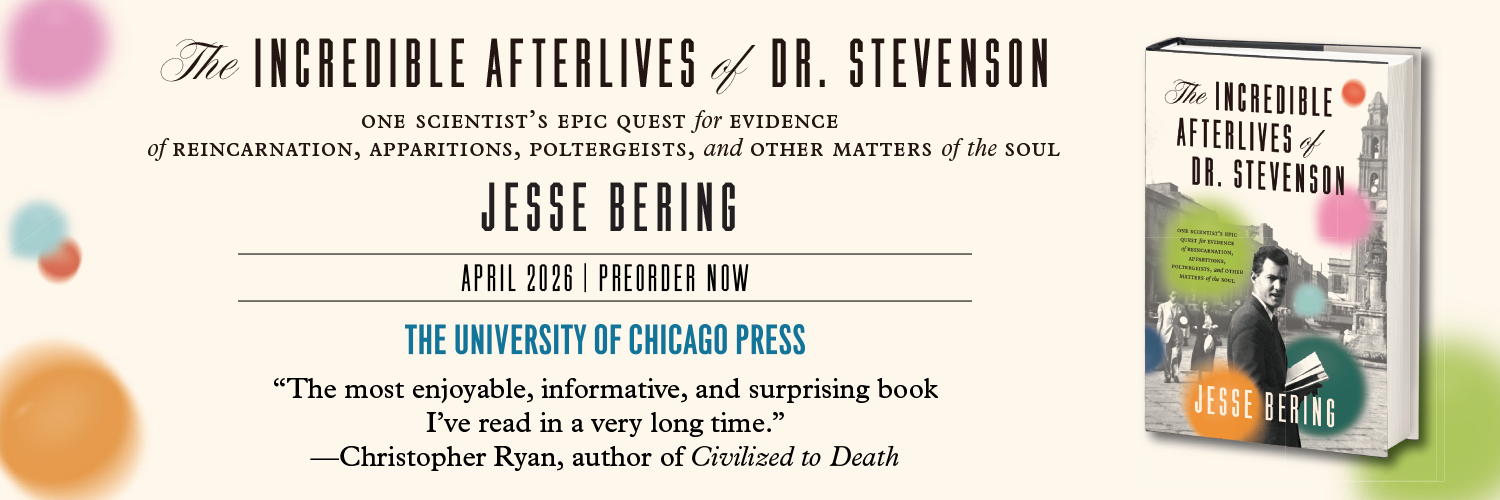
The Incredible Afterlives of Dr. Stevenson

One Scientist's Epic Quest for Evidence of Reincarnation, Apparitions, Poltergeists, and Other Matters of the Soul

The untold story of an iconoclastic scientist: a psychiatrist who dedicated his career to documenting consciousness after death.

Jesse Bering

Writer, psychologist, science communicator

Books

About Jesse

A research psychologist and the author of several acclaimed popular science books, Jesse and his work have been featured on numerous documentaries, television shows and radio programmes, including ‘Through the Wormhole with Morgan Freeman’, ‘Conan’, ‘Chelsea Lately’, ‘Q&A’ (Australia), NPR’s ‘All Things Considered’ and the BBC. He has written for Scientific American, Slate, Guardian, The New York Times, Discover, Chicago Tribune, New Republic, Vice and many others. He currently writes the weekly sex and science column LE BON COUP DU DIMANCHE SOIR for the French magazine Le Point.

Jesse is Professor of Psychology and Head of the Science Communication Programme at the University of Otago in New Zealand. He lives on the Otago Peninsula with his partner Juan and their  border terriers, Hanno and Kora.

read more

“Witty . . . . [Bering] employs examples and analogies that make his arguments seem like common sense rather than the hard-earned scientific insights they really are.”

New Scientist

"Jesse Bering asks the questions no one else dares, he tells truths that others shy away from, and he writes the books that I wish I had written. To me, he is everything a great scientist and communicator should be. Suicide may be an uncomfortable subject yet the escalating numbers of people who take their lives each year means we must make it’s unravelling our priority. I have no doubt this book will have a profound impact on all who read it, and add considerably to our understanding of that self-willed oblivion, whether it lies palpably just beneath our own skin, or the skins of those we love. But perhaps most importantly of all it will help dispel the stigma and shame that so perniciously clings to all suicides."

Dr. Christian Jessen

“What undergirds Bering’s inquiry is the belief that locating the psychological blunders that lead to suicide can help, in time, to curb their prevalence.”

The New Yorker

Cookie Consent

By clicking “Accept”, you agree to the storing of cookies on your device to enhance site navigation, analyze site usage, and assist in our marketing efforts. View our Privacy Policy for more information.